
 The international research network “SPACER” (Shaping Porous Electrode Architecture to Improve Current Density and Energy Efficiency in Redox-Flow Batteries) is developing novel architectures for porous electrodes. The researchers aim to increase the power density and energy efficiency of redox-flow batteries and pave the way to more affordable and durable long-term energy storage.
The energy transition has increased the demand for energy storage, including long-duration storage solutions like redox-flow batteries (RFBs), which can store electricity from renewable sources for hours or even days. A particularly promising feature of RFBs is the possibility to scale capacity independent of current. On the other hand, they have a high levelized cost of storage and limited power density, in part due to inefficient electrode use and the lack of tailored RFB components. These challenges have so far held back their widespread deployment.
This is where the international research network “SPACER” (EU Grant Agreement No. 101226997) comes in: 17 doctoral researchers from multiple countries are working together on a new generation of high-performance electrodes for redox-flow batteries. The goal is ambitious: The new electrodes are set to be 20 to 30 percent more powerful and up to 50 percent cheaper than today’s solutions, while achieving energy efficiencies above 85 to 90 percent.
Intelligent material structures on multiple levels
The research team is pursuing hierarchically structured multilayer materials that systematically optimize the flow of electrolyte and current within the battery.
These optimizations will occur on three levels – micro-, meso- and macroscale – across the entire development chain:
• Modelling: Computer simulations to better understand battery behaviour and identify optimal pore structures.
• Manufacturing: State-of-the-art techniques such as stereolithography, 3D printing and textile technologies turn the modelled structures into reality.
• Validation: High-tech imaging methods verify whether the prototypes meet model predictions.
To conclude the project, the new electrodes will be validated in near-application test setups by the industrial partner Pinflow Energy Storage S.R.O. – a key step towards market readiness (Technology Readiness Level 6). The results are intended for use in both established and next-generation flow battery systems, including vanadium-based technologies.
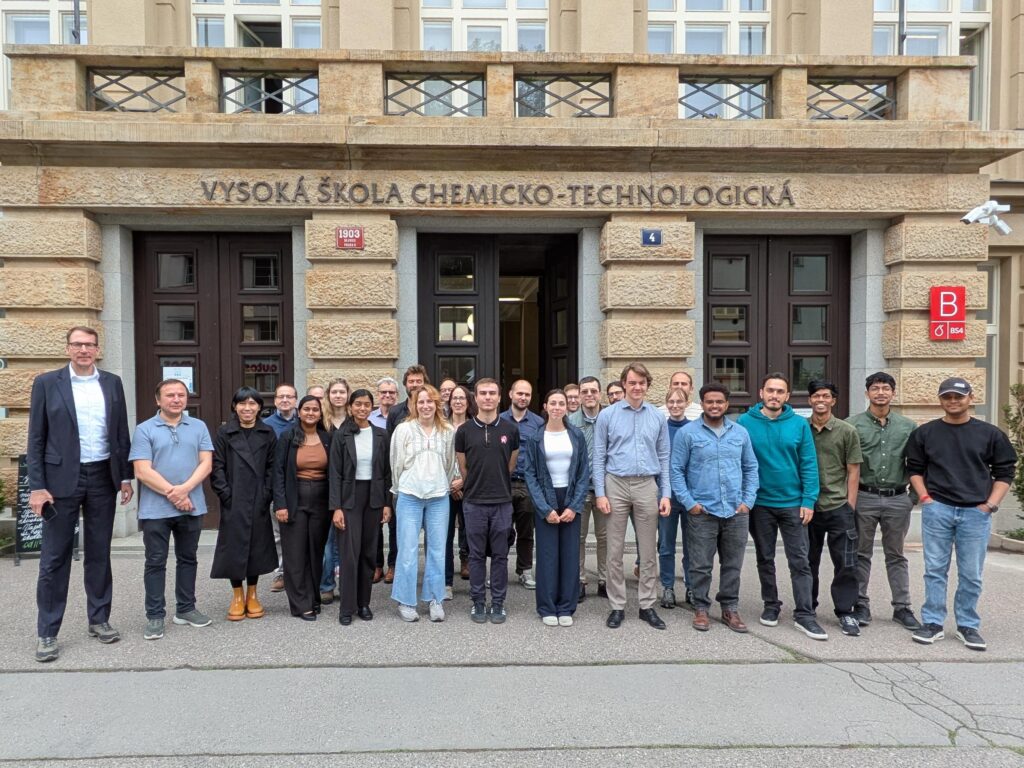
From 9-11th June, 2026 the first kick-off meeting with the doctoral candidates took place at the University of Chemistry and Technology Prague. Doctoral candidate Sritama Chakraborty, Fraunhofer ICT, comments as follows: “I am excited to be a part of the SPACER network. As a doctoral candidate, it is a unique opportunity to research the current flow battery technology and contribute to next-generation prototypes that will make sustainable energy storage more accessible.”
SPACER is led by the Fraunhofer Institute for Chemical Technology ICT and funded by the Marie Skłodowska-Curie Program of the European Union. Alongside its research objectives, the network aims to prepare its doctoral candidates for a future career in academia or industry. An interdisciplinary European consortium of industrial companies and research organizations will train each doctoral candidate in the skills needed to develop and integrate the new models, materials, and processes in electrochemical energy storage applications.
To find out more about the SPACER, please visit www.rfb-spacer.eu or contact the project coordinators at Fraunhofer ICT, Pfinztal, Germany.
Adj. Assoc. Prof. (UNSW, UQ) Dr.-Ing. Jens Noack, jens.noack@ict.fraunhofer.de
Carolyn Fisher, carolyn.fisher@ict.fraunhofer.de